
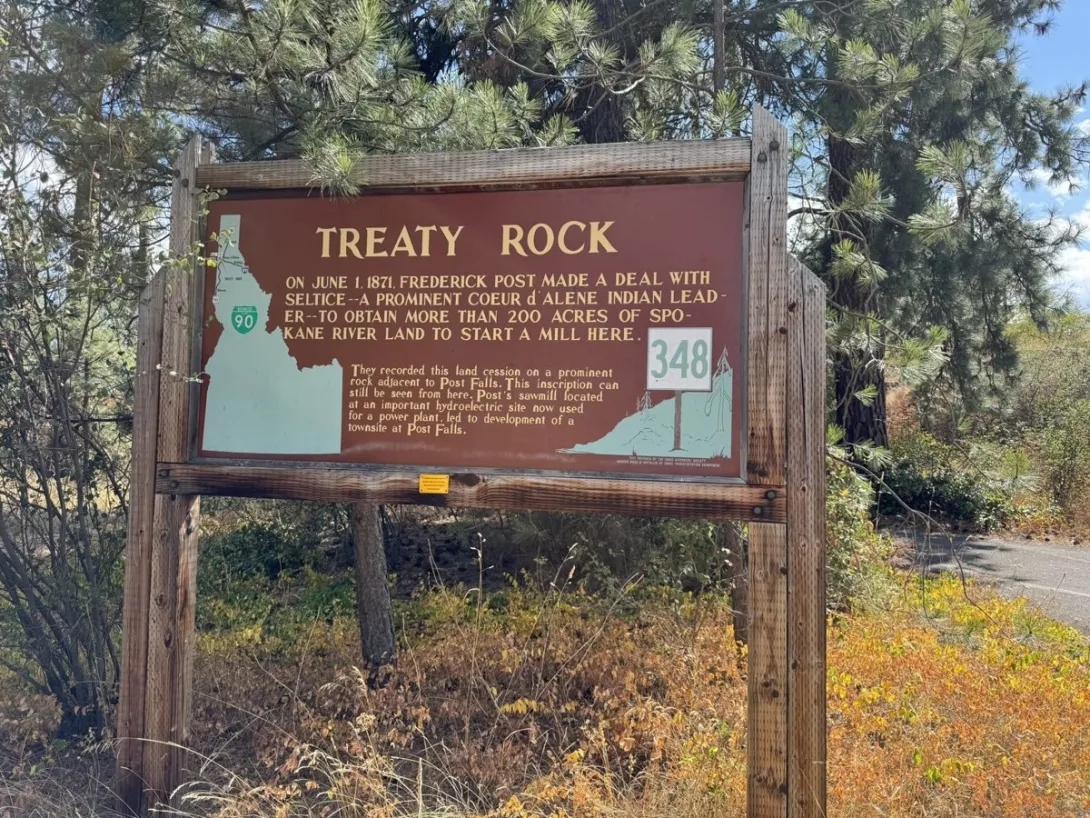
About nine miles below the outlet of Lake Coeur d'Alene, the Spokane River does something unusual. Rocky islands split it into three channels, each with its own natural falls, before the channels rejoin below a drop of about forty feet. When German immigrant Frederick Post reached that place in 1871, he saw what a millwright would see first: steady water power, waiting to turn a saw. The falls would give a town its name, but the land beneath them would take twenty years to become legally his.
On June 1, 1871, Post and Chief Andrew Seltice of the Coeur d'Alene Tribe made a verbal agreement. Post was granted two hundred acres on both sides of the river at the falls, then called Little Falls, so he could build a sawmill. In return, the Tribe was to receive finished lumber from the mill. The only lasting record was carved and painted on a granite outcrop nearby: Post's name and the June 1, 1871 date set above much older Indigenous pictographs, on the rock now known as Treaty Rock. Historians are careful here. There is no evidence the agreement was signed at the rock, and its National Register listing rests on its archaeology, not on a signing ceremony.
Post built anyway, long before the paperwork caught up. After time spent on business interests in Rathdrum and Spokane, he returned to the upper falls, and by 1880 he had developed the water-power site for a lumber mill at what became Post Falls. That work earned him a lasting local description as the father of commercial lumbering for the area. Yet the foundation under the mill was still a verbal promise made in 1871, in a homeland where the Tribe itself had no secure title from the United States and settlement kept pressing in.
The legal ending finally came at the end of the 1880s. In 1889 Seltice and the Tribe's headmen signed a treaty with the United States at DeSmet, and one week later Seltice signed an addendum involving Frederick Post. The final 1889 document carried a reference to Post and the June 1, 1871 date, and a statement Seltice signed continuing Post's title was recognized by an act of Congress signed by President Cleveland. The full arrangement was not legally completed until 1891. Only after its passage, a local history account notes, did Post have the land surveyed and begin selling off portions of the land surrounding the falls.
Seltice died in 1902 and Post in 1908, and the long transaction did not end in bitterness in local memory. A Post Falls oral history recalled by a Historical Society board member says members of the Coeur d'Alene Tribe rode their horses from the reservation to Post Falls to attend Post's funeral. Today Treaty Rock sits in a four-acre park at 705 North Compton Street, listed on the National Register of Historic Places in 1992, its panel shielded behind plexiglass and explained by three interpretive signs added in 2012. From Black Bay, it is a short trip to stand where a town began with a handshake, a falls, and a title that took twenty years to arrive.
- Log in to post comments