
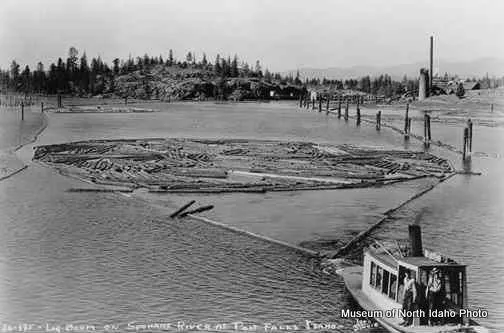
Stand on the shore at Black Bay today and the Spokane River looks like recreation: calm water, forested banks, a quiet cove. For much of the first half of the twentieth century, this same river was a working highway. North Idaho lumber companies used the region's creeks, rivers, and lakes to move timber from 1900 to 1948, and the current that slips past Black Bay carried logs downstream. A Museum of North Idaho photograph from the era shows what that traffic looked like: a broad log boom spread across the Spokane River at Post Falls, a small tug at its edge, and a riverside mill in the distance.
The work began in winter. Timber was sometimes harvested in the cold months, when crews could skid logs with oxen or steam donkeys across ice and snow to the riverbanks. There the logs were stacked, waiting for spring runoff to sweep them downstream toward the mills. It was an economical way to move timber out of remote forests no railroad reached, but never simple. Logs stuck on rocks, lodged in bends, and snagged on the bottom, and one stuck log could quickly build into a vast logjam.
Because several companies might use the same drainage, every log carried its owner's identity. Logs were branded on the end or given a mark cut into the side, much like a cattle brand on the open range, and each company's unique mark had to be registered through the State of Idaho. Downstream, logs were sorted by that brand or mark, gathered into a boom — a floating corral of timber — and towed to the mill, as in the Post Falls photograph, where a tug pulls the boom along a channel lined with pilings.
The men who guided the logs were known as river pigs, and they had three roles. Drivers pushed, pried, and pulled logs off rocks and debris. The rear, or sacking, crew searched behind the drive for strays stuck along the way. Out front, the elite jam crew cleared the first jams before the main flow arrived. Their tools were cork boots with rows of spikes for walking on slippery logs, a twelve-foot pole, and a peavey — a handle thirty to fifty inches long with a metal spear and a movable hook that let a driver grasp and roll a log. When they were not in the icy water, flat-bottomed boats called bateaux ferried the crews up and down the river.
Contemporaries said the river pigs seemed to waltz across the rolling logs in white water, gliding from one to the next with remarkable balance. The grace was real, and so was the danger: one slip, and a driver could drown or be crushed between a moving log and an immovable obstacle. Yet day after day they kept the timber moving — the human link between the forests upriver and the sawmills at the falls, on the stretch of river Black Bay residents know as their front yard.
The era ended before 1950. Timber grew depleted, landowners sued lumber companies over flooding and damage the log-filled rivers did to nearby farmland, and growing awareness of the environmental impact of river logging, especially splash dams, brought new regulations. The last log drive on Priest River ran in 1949, and Idaho's last drive, on the Clearwater River, came in 1971. Trucks, heavy equipment, and helicopters took over, and the river pigs became history. The booms no longer pass Black Bay, but on a still morning it is easy to picture a river paved with logs.
- Log in to post comments