
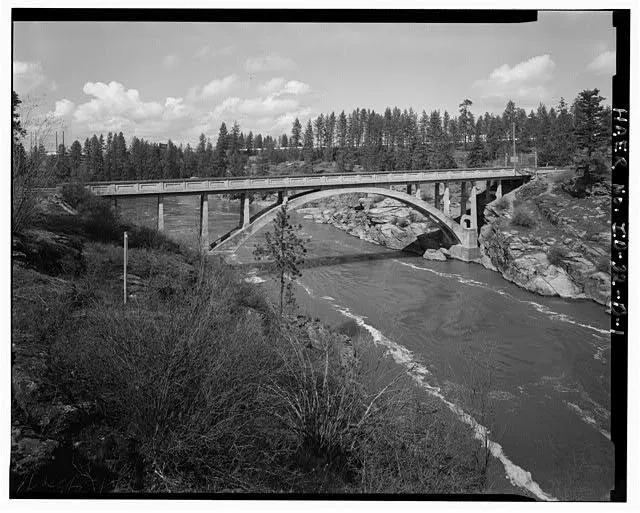
Downstream from Black Bay, at the western edge of Post Falls, Fourth Street narrows to a single lane and crosses two quiet concrete bridges on its way to an island in the Spokane River. The route looks modest today, behind the trees of Falls Park, but it was once the working lifeline of the Post Falls power plant. Before there was concrete, wooden bridges crossed the Spokane Valley Irrigation Company canal and the north channel of the river, and the wooden span over the river carried both railroad traffic and motor vehicles to the island while the dams and powerhouse were being built.
Washington Water Power, incorporated in Spokane in 1889, announced its Post Falls plant in 1903. The project raised dams on all three channels of the river where it divides around the islands at the falls, and built a large powerhouse planned for six units of 3,000 horsepower each. Work was well under way by the fall of 1905, the plant came on line in 1906 with three units working, and a fourth and fifth unit followed in 1907 and 1908. Through all of that construction and operation, every crew, wagon, rail load, and later motor vehicle bound for the island had to cross those wooden bridges.
By 1929 the company decided the wooden river bridge had served long enough. Officials signed the work order that August, WWP engineers designed a reinforced concrete arch, and Grant Smith and Company of Spokane took the contract, with chief engineer V. H. Greisser and consulting engineer B. J. Garnett overseeing the design. Work began in September 1929, the old wooden bridge was removed within a couple of weeks, and the new span was nearly finished by the end of the year. The park monument records its final cost as 22,948 dollars.
The finished bridge was a graceful piece of engineering. Its open spandrel arch, built with two parallel ribs set on bedrock, stretches 221 feet in thirteen sections and carries its deck about forty feet above high water, with the arch itself rising just over thirty-two feet. In May 1930 the project grew to include a smaller concrete bridge over the irrigation canal, a sixty-foot flat girder span built that spring, so the whole approach to the island was renewed in concrete. Together the two bridges cost about 28,260 dollars.
The National Park Service later judged the pair excellent examples of early twentieth-century concrete bridge building, and listed them in the National Register of Historic Places on December 20, 1996. The larger span is the oldest identified open spandrel reinforced concrete arch bridge still standing in Idaho, and one of only four of its type known to remain in the state. It still serves as the only access to the island for the maintenance and operation of the Post Falls Hydroelectric Development, a working bridge that most visitors to Falls Park see only as a handsome arch above the gorge, just a short river walk from Black Bay.
- Log in to post comments